
A1–A2 · Vocabulary and false friends
English–German false friends
Compare gift, rock, hell, chef, kind and fast in English and German with illustrated examples, context and six practice questions with answers.
Dilelang · Updated on
What are false friends?
False friends are words that look or sound alike in two languages but have different meanings. English can help you learn German, yet a familiar spelling can also lead you to the wrong interpretation. These six everyday comparisons explain the meanings and the context, rather than assuming that every word has only one translation.
The six pairs at a glance
| English | German |
|---|---|
| gift — a present | das Gift — poison |
| rock — a stone or rock | der Rock — a skirt |
| hell — hell | hell — bright or light |
| chef — a professional cook | der Chef — a boss |
| kind — kind-hearted; also a type or sort | das Kind — a child |
| fast — quick | fast — almost |
gift / das Gift
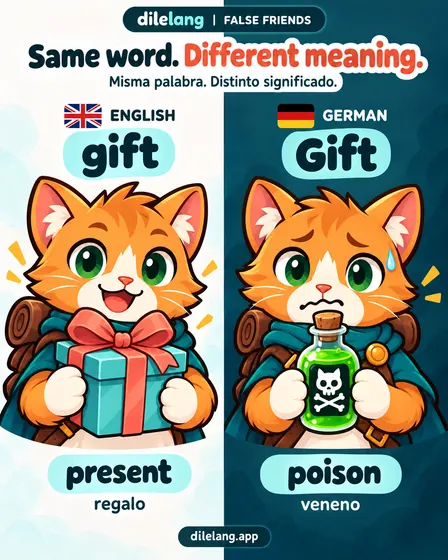
English: gift — a present. German: das Gift — poison.
For a present in German, use das Geschenk. Das Gift means poison: mistaking one for the other completely changes your message.
Example: Das ist kein Geschenk, das ist Gift. — This is not a present; it is poison.
rock / der Rock
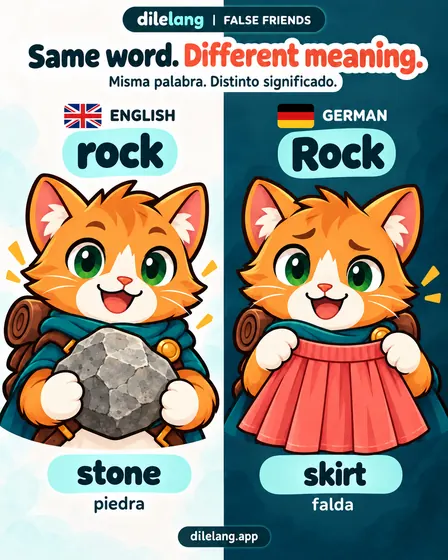
English: rock — a stone or rock. German: der Rock — a skirt.
Der Rock is a skirt. A stone is der Stein; a rock or crag can be der Fels. German also uses Rock for the musical genre. This comparison concerns the clothing and stone meanings.
Example: Der Rock ist rot. — The skirt is red.
hell / hell
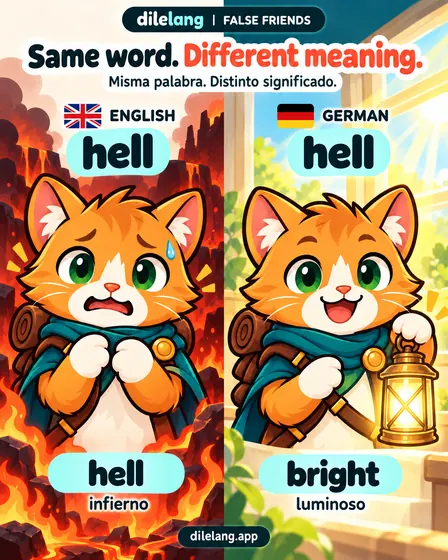
English: hell — hell. German: hell — bright or light.
Hell describes brightness or a light colour. The German word for hell is die Hölle. Similar spelling does not mean identical pronunciation.
Example: Das Zimmer ist hell. — The room is bright.
chef / der Chef
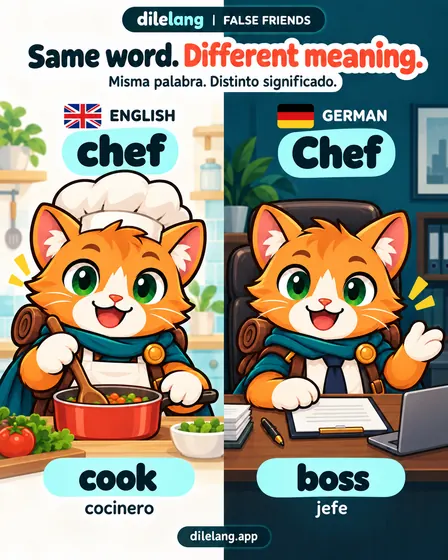
English: chef — a professional cook. German: der Chef — a boss.
Der Chef runs a team or business; the feminine form is die Chefin. English chef refers to a trained professional cook; Küchenchef is the head of a kitchen. A German Chef can work in other industries.
Example: Mein Chef ist heute im Büro. — My boss is in the office today.
kind / das Kind
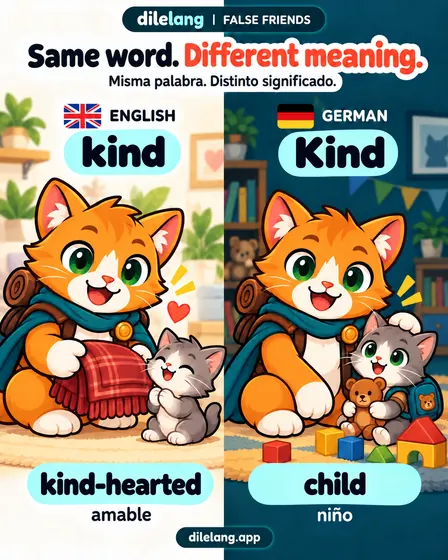
English: kind — kind-hearted; also a type or sort. German: das Kind — a child.
Das Kind means child; the plural is die Kinder. Translate the adjective kind as nett or freundlich. The noun kind, meaning a type, often corresponds to Art: context matters.
Example: Das Kind spielt. — The child is playing.
fast / fast
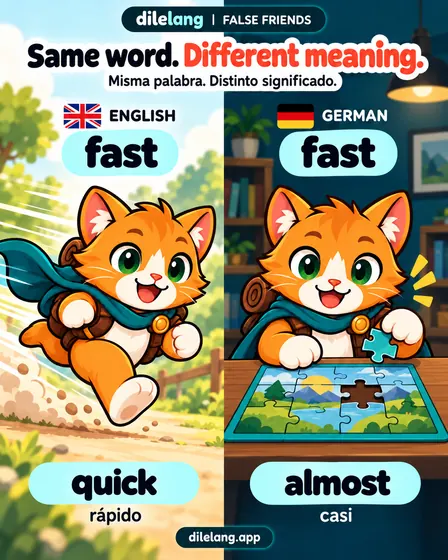
English: fast — quick. German: fast — almost.
Fast means something is close to happening or being complete. Use schnell for quick. Fast fertig means almost finished, not finished quickly.
Example: Ich bin fast fertig. — I am almost ready.
How to remember the difference
Learn each German noun with its article and a sentence instead of memorising a word alone. Capital letters help identify German nouns but do not guarantee a shared meaning. Always check the context: a word can have several senses.
Check what you learned
Choose the correct answer. After answering, you will see the solution and its explanation.
Continue with German articles.
What would you like to practise?
Complete the sentence:
Situation

Your result
Review the topic you found hardest:
Keep practising with Dile
Practise German step by step and review your mistakes in the app.
Download the appEnglish–German false friends: 6 misleading words
- Die Flasche enthält ___.Gift · Rock · hell · Chef · Kind · fast
- Sie trägt einen roten ___.Gift · Rock · hell · Chef · Kind · fast
- Das Zimmer hat große Fenster und ist ___.Gift · Rock · hell · Chef · Kind · fast
- Mein ___ leitet die Firma.Gift · Rock · hell · Chef · Kind · fast
- Das ___ spielt im Garten.Gift · Rock · hell · Chef · Kind · fast
- Ich bin ___ fertig.Gift · Rock · hell · Chef · Kind · fast
Show answers and explanations
- Gift — Gift — poison.
- Rock — Rock — a skirt.
- hell — hell — bright or light.
- Chef — Chef — a boss.
- Kind — Kind — a child.
- fast — fast — almost.
Further reading
The explanations and exercises in this guide are by Dilelang. Explore or check the concepts in these sources: